A shared, exact ledger for money between people — encrypted on the device that
writes it, so the only party who can read your expenses is the group that spent
them. Shipping as an Android app built from one shared Rust core, with the
product site live on the web.
Splitting costs with friends shouldn’t mean handing a company a map of your life.
Every shared expense says something about you: who you live with, who you travel with, where you were and what you spent. Most bill-splitting apps store all of it in readable form on their servers, and many fund themselves through ads or by limiting what free users can do. Meanwhile, the alternatives — a spreadsheet, a notes app, one friend “keeping track” — are error-prone, lose cents to rounding, and fall apart when someone disagrees. Forretas nas Contas gives groups a shared, exact ledger that nobody but the group can read, including us.
Your spending is someone else’s data.
End-to-end encrypted; we can’t read your bills.
Every expense is encrypted on the phone that entered it. What reaches a server is ciphertext, so there is no readable expense list to mine, leak, sell or hand over.
“Free” usually has a catch.
No ads, no data selling, and joining is always free.
The product is paid for by the people who create more than 3 projects: if you need more, you can subscribe.
Privacy is often an upsell.
Every privacy and security feature is free.
Spreadsheets and mental math go wrong.
Exact to the cent, every split adds up.
Splits are computed in integer minor units, so the parts always sum to the exact total.
One person ends up as the group’s accountant.
A shared history everyone sees, where every change is recorded.
Apps fail where trips happen: abroad, on roaming, in places with no signal.
Keeps working when the network doesn’t.
An expense is written to the phone and returned to you immediately; synchronisation catches up in the background when there is a connection, never as a condition for recording what you spent.
Getting everyone on board is a chore.
Add friends as names; they join later, or never.
Your data is hard to take back.
Delete your account in the app anytime.
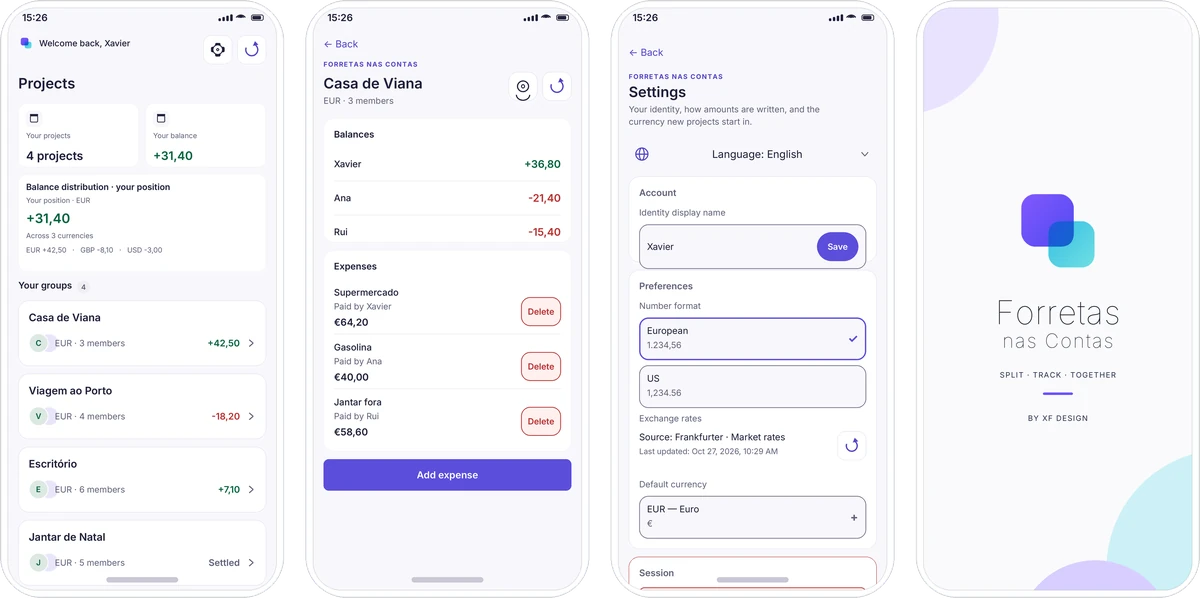
Splash & identityThe app opens on the mark and the promise: split, track, together.Your groupsProjects, your net position and every group in one list — readable at a glance.One project, in fullBalances, the expenses behind them, and the one action that matters next.PreferencesNumber formats, default currency and where your recovery code lives.Design ConceptOne mark, two overlapping forms — the visual shorthand for two people sharing one cost.
The landing pageThe same engine in the browser: an example split, computed live, with the encryption notice where people look for it.Trust, stated plainlyThree promises and three steps. The privacy claim is made in the same breath as the joke, so neither reads as marketing.The promise, above the foldTrust is a design decision, not a footnote: the split is shown before anyone signs up.
What it promises
Fourteen things that are true of the product today. None of them is a roadmap item, and
none of them is reserved for a paid plan.
We can’t read your bills.Every expense is end-to-end encrypted on your phone. Our servers only ever store scrambled data.
Joining is always free.Friends you invite never pay. Only organizing more than 3 groups needs Plus.
Privacy is never a paid feature.Encryption, invites, and sync are identical on free and paid.
Works offline.Add expenses on a plane or in a basement; they sync when you’re back online.
Instant.An expense is saved on your phone the moment you tap Add. No waiting on the network.
Join in seconds.Scan a QR code or tap a link and you’re in, even if the organizer’s phone is switched off.
No one can be slipped into your group.The invite secret travels in the link itself and never reaches our servers, so not even we could add someone.
Exact to the cent.Splits always add up to the total exactly, and leftover cents are assigned by a fixed rule. Rounding never silently loses money.
Not everyone needs the app.Add friends as plain names; they can install it later and take over their spot, history included.
Leave cleanly.Remove a project and it’s gone from your phone; the group keeps its history.
No ads, no data selling, ever.We make money from one subscription, nothing else.
Your key, your data.Only you hold your recovery code. A new phone gets all your projects back with it.
Delete your account anytime,in the app, and your project data is erased.
Speaks your language:8 languages, including right-to-left Arabic.
How it’s built
One audited Rust coreA single implementation of money math, encryption and the ledger, compiled for every device the app runs on. One behaviour to test, not one per platform.
Event-sourced ledgerBalances are recomputed from immutable history. Nothing stores a running total that can quietly drift away from the events that produced it.
Per-device append-only logsEach device owns its log and only ever appends. Devices cannot overwrite one another, so a phone that was offline for a week cannot clobber a change it never saw.
Deterministic mergeLamport clocks order concurrent events; ties break on event content. The same set of events merges to the same ledger everywhere, with zero coordination between devices.A Lamport clock is a counter each device carries with the log: it ticks forward on every local event and jumps ahead of any timestamp it receives from a peer. Two devices that edited while offline therefore still agree on which change came first — by number, without asking a server.
Hash-chained logsEach entry commits to the one before it. Truncation, reordering and tampering are detectable — integrity without a blockchain or a server to trust.
Vetted cryptography onlyX25519 sealed boxes and standard primitives. No home-made ciphers and no novel protocols, because the failure mode of clever crypto is silence.
Hybrid encryptionOne symmetric key per project, sealed individually to each member’s public key. Adding a member re-wraps the key; it never re-encrypts the history.
GDPR erasure by designContent and billing live in separate subsystems. “Delete my account” erases content while legally retained tax records stay exactly where the law requires them.
What this costs you
Lose the phone and the recovery code, and the data is gone.
That is the direct consequence of encryption done properly. Nobody at Forretas holds
a copy of your key, so nobody — including us — can restore an account that has lost
both. Store the recovery code somewhere you will still have it in two years.
Joining a group is not unconditionally trustless.
The invite secret travels in the link and never reaches our servers, so we cannot add
someone to a group. A server-mediated invite still relies on the service returning the
genuine public key of the person joining — the same posture every end-to-end
messenger accepts. The QR path removes even that window.
Android only, for now.
The shared Rust core is portable, but a client is not a core. Until an iOS client
exists and has been tested, this page will not imply one does.